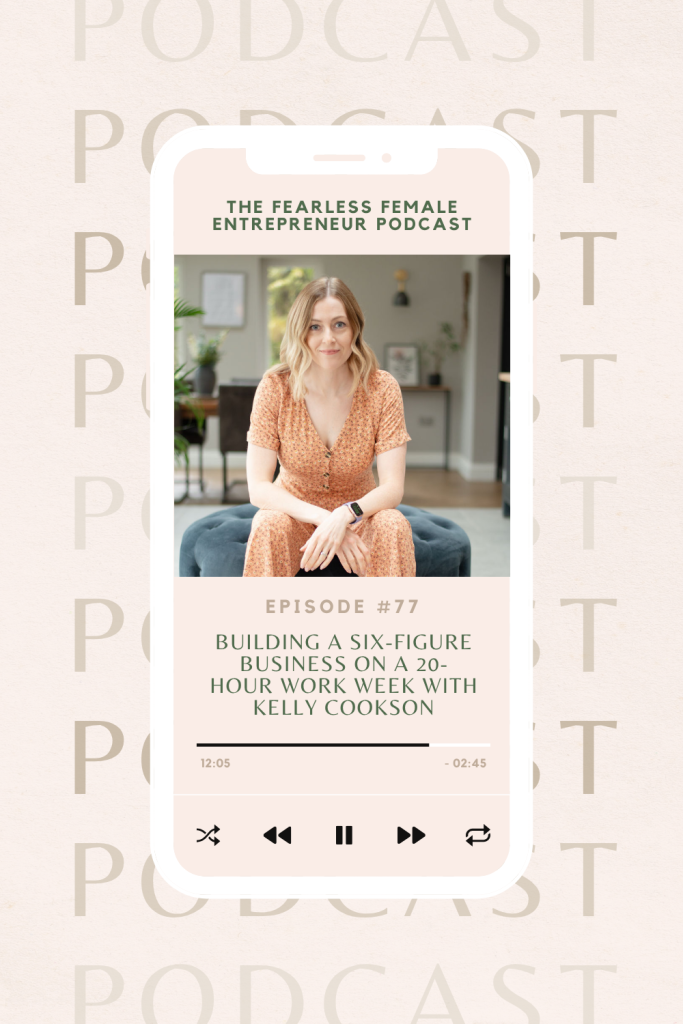
How to Build a Six-Figure Business on a 20-Hour Work Week with Kelly Cookson
Ever wonder if it’s REALLY possible to work just 20 hours a week and have consistent financial freedom? Well, your answer is here!
In this special interview, I had the pleasure of sitting down with Kelly Cookson, a marketing strategist, copywriter, and email marketing expert. Kelly has achieved what many dream of: a six-figure online business while working just 20 hours a week. With over 16 years of marketing experience, Kelly shares her incredible journey and invaluable insights into building a thriving business on your own terms.
Join us as we dive deep into retraining your brain, embracing your “zone of genius,” and the real talk about what it takes to find true freedom in entrepreneurship.
Here is a snippet of our conversation together on this episode of The Fearless Female Entrepreneur Podcast:
Katerina: Kelly, welcome to the Fearless Female Entrepreneur Podcast! I’m so excited to chat about the 20-hour week and the six-figure business. I think it’s hard to fathom that we can just work 20 hours a week. We are so trained that we need the 40-hour work week to get everything done because that’s what we started with in the corporate world. It’s hard to retrain your brain to think, “Oh my gosh, I can have a life.”
Kelly: I haven’t worked full-time since 2016. Full-time for me was Monday to Friday, 9 to 5, as a marketing manager for an international software company. The only reason I went part-time was because in the spring of 2017, I had my daughter. I went back to work doing what I did two days a week for about three months, and then three days a week, and then I just stuck at three days a week for about two and a half years before then becoming an entrepreneur. It just feels like such hard work. But I think as entrepreneurs, you do work in your mind a lot of the time when you’re not physically at a desk.
Katerina: I was actually talking to a friend yesterday, and she got a salaried job, but she has to clock in and out. She’ll call me, and she’s like, “Oh, I have to stay on an extra hour because I had to take my dog to the vet or my kid to the doctor, and I had to clock out, and then I had to clock back in.” I’m like, “Oh gosh, that sounds so awful!”
Kelly: Yeah, it’s such a backwards way of working. “Things will take as much time as you give them” is one of my personal mantras. If you’re going to have a 40-hour week, you will fill those 40 hours. But it’s amazing when you are restricted in terms of working time available, due to whatever reason—whether it is being a parent or health, or you just have a life outside of work—how much you can get done in less time.
Katerina: It’s kind of a lack of trust. I remember working at a job where I had to get up at 5:30 to catch the train, and my work hours were 8:30 to 4:30. I would get in at 8:36, and the HR manager would come and say, “Well, you weren’t in your seat at 8:30.” She was wanting me to work an extra half hour to make up that six minutes. To be in that environment where you don’t feel trusted is kind of, I don’t know, it just doesn’t feel good.
Kelly: No, it’s not the makings of a flourishing long-term career, is it?
Katerina: Definitely not. So, tell us about how the switch happened from your full-time to the gradual move into your business.
Kelly: So I did have a secret side hustle. A friend that I used to work with reached out to me and asked, “Are you up for doing a bit of marketing on the side for me, for my business?” I said yes. And then her husband, who’s also an entrepreneur, said, “Well, can you do a bit for me?” It really just started from there, where it got to the point within a few months I was making half of my pro-rata salary, my three days a week salary, on the side hustle. I had no marketing. It was just from a few people reaching out and then word spreading, “Kelly’s doing a bit of marketing now.”
I really enjoyed it because in the time that I wasn’t at my day job, I had two days, I think I used to have like Wednesdays and Fridays off at home with Penny [her daughter]. She would still take a two-hour nap, and I used to get a bit bored, so I could just crack on and earn a bit of money doing these marketing campaigns and doing a bit of copywriting while she was asleep. It felt like easy, exciting money. After doing that for a few months, I thought, well, if I actually marketed myself and advertised that I do this, I’m pretty sure I can match what I’m making in my three-day-a-week marketing manager job from this side hustle. That was it, really, that planted the seed. I handed in my notice in January 2020, just before the global pandemic. That’s how I made the leap.
Katerina: That’s really cool. It’s kind of like you had to open up and be like, “Oh, wait a minute, there’s something else out there that I can do that works for me better.”
Kelly: So I did have some attempts at side hustling before the marketing thing. I think because I had that spare time at home with a toddler, I was itching to expand my creativity and earn a bit of money on the side. Before doing the marketing thing, I had a few random side hustles. One of them was I used to flip clothes on eBay and reselling sites. I did find a Burberry jumper for £4.50 here in the UK, and I sold that on for £45. I was like, “This is amazing!” But what happened with that was it took so long to launder the clothes and then display the clothes, upload the clothes, package, take them to the post office. So although I did make a few hundred pounds profit, it was like, “This isn’t a viable business.”
Then I used to listen to a podcast called the Side Hustle Podcast or something, or Side Hustle School, and there was a woman on there who was making $6,000 a month drawing people’s pets and selling pet portraits. So I tried to draw cats and that never got off the ground, never sold a pet portrait. But there were things like that where I was just dabbling.
When this marketing opportunity landed, it was like, “Oh, I kind of already know how to do this. I’ve been doing it for, what, 12 years as a job?” And I don’t have to buy any or wash any smelly clothes or try and draw my pet. I can just make money doing what I already know how to do. It was like, “Oh, actually, this is better than those other things.”
Katerina: I think we all fall into the game. They make it sound so easy, like, “Oh, you can sell all these digital products and it’s so easy.” It’s like, not as easy as they say.
Kelly: The lesson for me was, “Well, I’ve already, this is literally what I have a degree in doing this, and I’ve been doing it for 12 years.” All I need to do is ask people in my network that I’ve already worked with in some capacity, or they know people, and say, “Oh, I’m doing freelance marketing now, who needs this service?” It was like it was easy money and I enjoyed doing it. So I guess that was the lesson from failed side hustles: stick with something that’s actually your zone of genius and that you can monetize.
Katerina: I think it’s the thing that feels easeful, like it’s not an uphill battle. It’s not some big, huge learning curve. I think we underestimate easy. I used to discount my skills all the time, “Well, it’s easy for me,” and people, “It’s not easy for everybody else.” There’s like a mindset around how we discount the things that come easy for us are probably the things we’re meant to be doing.
Kelly: Yes. And the things we have learned or invested time, money, and energy into learning and honing those skills. This is something that I see with a lot of female entrepreneurs especially, is that undercharging. I did realize that the marketing came to me easily because I was very experienced in it, but I still had no idea what to charge people for that service. I massively undercharged those first six months of running my own business.
I remember my first retainer client that I got in January. I charged him £950 a month for the services that I was doing. The guy bit my hand off. I think he knew it was a great deal. For me to ask him for £950 a month for minimum of three months, I sweated. I sweated over that proposal. When I hit send on the email, I was like, “Oh my God, £950 a month, this is so much money.” And then he was straight away like, “Yeah, sign on the dotted line, let’s go.” The amount of work that I did for that, I did work hard. And we ended up, in fact, he ended up being one of my best clients. We worked together for three and a half years in the end.
Katerina: Yeah, and I think there’s like a rite of passage. I remember getting my coaching certification, and I was struggling to find clients. I offered a discount: three in-person sessions for $150. It’s so hard to ask for the money, isn’t it? You think, “Oh, that’s a lot of money.”
Kelly: And, you know, in different contexts, it is a lot of money, but it’s not a lot of money for the qualification and the reason you get the client, right? You just learn from that moment of resentment.
Katerina: One of the clients that took me up on that, she didn’t even show up to the session. I had driven like 30 minutes to meet her. So I went there. She didn’t show up. I tell people this when we get into our coaching sessions, and they’re talking about pricing. It’s like, just set what you feel good saying in this moment, and you’re going to naturally know if it’s a good fit moving forward. Get to the point where, “Okay, I can say this number, I don’t want to throw up.” And then once you’re working with those people, you’ll either feel like, “Okay, this is a good price, I’m going to keep it,” or “I feel resentful because I’m doing all this work.” And then you just know, naturally, “Okay, it’s time to raise my price.”
Kelly: Sure. I mean, the £950 a month thing, I loved working with that business. They were great, and I learned a lot. But I’ve done things for a lot, lot less money, like one-off projects for like £300 or even less than that. I only took those projects because of the pressure of needing to make all of my own money. So I ended up, actually, six months into my business, I burnt it down and broke up with 90% of my clients. Not that one guy that we ended up working together for a long time, but most all of those little jobs or little retainers that I had, I let them all go because my head was spinning. It didn’t help that it was lockdown in the UK. So I was at home with a three-year-old that I hadn’t bargained for, like full-time. I just felt exhausted.
Six months in, I was like, “Right, I’m not doing this kind of work anymore.” I’m not writing another brochure. I’m not doing certain businesses that I don’t want to work with. I want to work with solopreneurs on their email marketing, which I love. Once I made that shift, everything took off. But it was scary because I had to say to people, I had to turn down work, and the universe tests you. I don’t know if you’ve had this, but when I drew that line in the sand, “I’m not doing this anymore,” those opportunities kept coming. I kept having to say no, which is testing your willpower. But it was after that that things took off.
Katerina: Yeah. So what you’re talking about is growth mindset. It’s like learning from challenges and mistakes and or failures, if you want to use that word.
Kelly: I think there’s two ways it goes. It’s either you learn from the things that you did wrong or that didn’t work out so well, and then you put into practice, “Well, I will do this differently next time,” and then you grow. So, growth mindset. Or there’s the other way, which is the fixed mindset, where you think, “Well, why does this always happen to me? Why do I keep getting low-paying jobs? Oh, I can’t get anybody that’s going to work with me that’s a dream client, or I’ll fail to do it this way. It won’t work out.” So it’s like victim mindset, and then there’s no learning from what went wrong.
I think looking back when I let go of a lot of those clients that I didn’t want to work with anymore and changed my business, I did it very mindfully of, “I don’t want to do that anymore. That didn’t work well for me. That was a bad experience.” So what can I change now, moving forwards, and then stuck to that? But I do see people get trapped in that loop of, “I need to earn the money, so I’m going to take on that job,” or, “Well, it’s hard to get clients, so I’m going to keep undercharging or I’m going to keep discounting.” And then they can’t break free and move forwards. I think that’s part of being an entrepreneur: you have to develop the growth mindset to look at what you’re doing critically, and then make moves and changes.
Katerina: I mean, as an entrepreneur, entrepreneurship isn’t business because you’re not separate from your business. Even if you have an LLC, it’s still yours. It’s still your vision. It’s still you doing the work. And if you want your business to grow, you have to grow too.
Kelly: And you know, so this is so interesting. I think so, like, you tell me about your corporate employed background. But we never had any kind of personal development training around mindset in the roles I’ve worked in. It was only when I started my own business that around that four to six months point where I had my burn it all down moment, start again almost, where I learned about mindset coaching. I’d never heard of that before.
Since I’ve been running my own business, I feel like I honestly feel like as much as 90% of success and getting to where I… I’ve been running a business for five and a half years now, pay all my own bills, all the holidays and all the cool stuff my business has afforded me for the last five and a half years. I think 90% of being able to do that is in my head. The strength to keep going and to keep learning and to wake up in the morning and actually believe, “Oh, I can do this,” because the minute that you start to think, “I can’t do it, it’s all turn into rubbish,” then…
Katerina: Yeah, You take action from your mindset. You don’t take action just to take action. You’re either going to take action because you’re thinking, “I believe that this is going to work, and I’m going to take action,” or it’s, “I’m afraid, I don’t know if it’s going to work, but I’m going to do it anyway.” But if you are too afraid, you don’t know if it’s going to work, you don’t want fear of failure, fear of judgment, and that’s going to just paralyze you. And then you’re not going to take action. So there’s no growth. If you don’t take action, you’re just going to stay where you are. You’re going to feel stuck, frustrated, stagnant, defeated, unmotivated.
Kelly: But, you know, to be clear, I didn’t wake up with a mindset of, “I’m a successful entrepreneur,” so I didn’t. I was the opposite. I was like, “This is really hard. Like, oh my God, all the pressure of making my own money, and I don’t want to go back to work.” I know I have to make this a success, but I think when I talk about the 90% of that mindset helping me to run a successful business, it’s because I invested in my mindset with coaching. As soon as I got somebody to help me in terms of the mindset coaching, actually helping me to figure out what my bigger vision was… I don’t think I would have built the business that I’ve got now if I didn’t have that support. I’ve always had a coach or a mentor over the last five years of business. Never done it on my own.
Katerina: And I think a coach is able to, like, kind of see those, get to know you enough, and your thinking enough to be like, “I see what’s holding you back.” Or “I see… it’s not even just your mindset on your confidence or your fears, your doubts, your limiting beliefs, but it’s also being able to recognize, like, okay, you’re taking this action out of lack or out of fear, as opposed to taking action out of the possibility.”
Kelly: And, you know, that sounds like a really scary position to be in. But with the mindset stuff, it’s also an incredibly exciting position to be in. So, you know, the 3 AM moments where I wake up and think, “What if I never make a sale ever again?” And this is it, and I’m not going to make any money, or, you know, the next day when the sun is shining and I’ve done my mindset work and I feel great, it’s like, “Well, the world is my oyster.” I can go out there. There are thousands of people that need my service, the money-making possibilities for me and my business while still retaining that flexibility that I want. You know, I work a 20-hour week. The possibilities are absolutely enormous, way bigger than anything that was ever available to me within my corporate role.
Katerina: And that’s another like positive psychology thing with hope. Hope for the future. And limitless possibilities when you become an entrepreneur, which can be daunting because there’s limitless decisions, so many opportunities. Which one do I pick? But also it’s such, you know, if this doesn’t work out right now, you can quickly do something else to make a quick buck. You’ve proven there’s always something.
Kelly: Yeah, I had a coach say that to me, actually, which in the 3 AM moments is really helpful. It would be like, “When have you ever not made the money? Or, like, when have you ever not paid the tax bill? Or when have you ever not paid yourself?” Like that doesn’t ever happen. So I have to remind myself, like sometimes the catastrophes that you think of, it’s like, “Well, that has never happened. Probably not going to happen.”
Katerina: So that is a really good reminder, actually. Things are always working out for me. That’s another mantra that I love. But you’re right. Mindset is such a big piece. And I think we have to unwire and rewire our brains. We have taken in so much about how we have to live life. I remember the biggest obstacle of becoming an entrepreneur for me was breaking free from the 9-to-5 mindset to a, “I now have control over my whole schedule.” Like, “I guess you can go to the gym at 11 AM or you can do your doctor’s appointments without taking annual leave.”
I remember I used to blog, I still blog, but years ago, that’s how I started my business. I blogged and I would, I was working with a coach, and I would sit outside with my dog and I’d be in my little cute rocking chair, and I’d be writing my blog. And it would never post those blogs ever. And my coach was like, “Why?” And I’m like, “Because it doesn’t count.” In my brain, it’s such a warped mindset. It didn’t count because I was having fun sitting outside in the beautiful weather, writing.
Kelly: So one of the quickest ways to make more money as an entrepreneur that I’ve found is to charge money for things I enjoy and come easy to me, and that I’m good at. With the copywriting and the email campaigns, I can look at people’s campaigns. This is about charging for the years of experience, not the actual minutes or hours it takes for you to do the job for the client.
The minute I drew that line in the sand six months into my business and wrote a list of things that I wasn’t going to do anymore, and the things that I were going to do were just in my zone of genius, which was a very small list. So I immediately felt like, “Well, I’m now restricting my moneymaking opportunities because 70% of the work I was doing, I’m not going to do that anymore because I don’t enjoy it. It’s too hard. It feels like hard work.” I’m going to stick to the 30% that I really enjoy, is easy for me, and I can get into flow doing. So it’s like I can do it quickly and to a high standard. You think, “Well, surely I’m going to miss out on all of the money that I would have got from the 70%,” but instead the opposite happened. It just took off. And the following months, I made more money than I’d ever made in my business, and it felt so easy and fun.
Katerina: I think people feel that energy shift. I know for me, I’m loving my business now. I felt like I was pushing uphill, trying to do “I’m going to show up and do reels.” I hate reels, I don’t want to do reels. I don’t want to do TikTok. As soon as I started just, “I’m going back to blogging and I’m going to go back to…” and I like writing, so we’re very much of the same kind of. And I could do it, and I could do it all day long. And that one means consistency because you’re going to keep showing up because it’s fun and you like it. People feel that energy, like, “Oh, she loves this.” I think it gets to be that simple. Choose the thing that feels fun and easy and just go do it over and over and over and over and over again and show up for it.
Kelly: So I like you, I can always tell when I’ve written something. So say I’m writing an email for my own list to send for my own marketing. You know, when you sit and you write, you’re like, “Oh my God, this is really good.” And then when you hit send on that, and then you get replies or sales or whatever comes from that email, it’s like, “Yes!” I feel like there is energy behind that when you hit send versus, “Oh, well, I’ve just had to like quickly write this or I’ve used AI to like put some together.” I’m not really that happy with it, but I need to be consistent. And then you send and then you get nothing back because, well, maybe the content wasn’t great, but also the energy behind it was a bit there.
Katerina: So I have a question for you because I think you were able to build this 20-hour workweek. I think one of the stumbling blocks, because everybody’s like, “Be visible, be everywhere, be consistent, show up every day.” I think what happens is, I am guilty of this for sure, is not being able to identify or focus on the revenue-generating, the most important tasks in order.
Kelly: Yeah, a good question. I think I am a time tracking nerd also. So I use a time tracking tool called Toggle, which is free. I’ve toggled for the entirety of my business. So I can go back and see how much time I’ve spent on client projects. So that’s helped me to figure out pricing. I also use it for my own marketing and sales time, and I can see there’s a direct correlation between the amount of time that I put into marketing and sales and my revenue. So for me, a revenue-generating task is marketing. The minute that I stop doing marketing… well, not that I do, because I’m a marketer, so I’d never not do the marketing. But when I see clients or speak to other solopreneurs, they go on that feast and famine roller coaster because they market their business, they market their business, they get clients, they’re so busy, they stop marketing their business, and then they finish those clients, and then they’ve got no clients coming in because they haven’t done the marketing. My point is, but that that roller coaster of like, “Oh, I market, so I’m busy, then I’m too busy to market.” So that for me is one of the most important things to sort out: a revenue-generating task for long-term sustainable income into your business is marketing. Every week, every month, every day, I am doing marketing and sales activity. So that’s a revenue-generating task.
I also know that things like figuring out my offers or delivering great client resources is also a revenue-generating task because if your clients can’t recommend you, then you have a problem. One of the easiest ways to get new clients is for your clients to share the word about you, about how great you are and how you’ve helped them. So that is a revenue-generating task. But I see that a lot of clients, or my clients, or businesses I’ve worked with, tend to put the client work first, so that that overruns, and then they never get around to doing the marketing. So although I’m very conscious of delivering results to my clients, I actually start the day with my own work, if you like. So the first hour or two would be dedicated to my revenue-generating tasks. Have I created that sales page? Can people purchase that thing? Have I started conversations with my ideal clients on Instagram? Have I sent the email? Have I done the work? Yes. Great. Okay. Afternoon is for clients.
Katerina: Yeah. No, I think that’s great. I think there has to be a balance between marketing, a consistent balance, as I am guilty of, “Okay, I got my clients, and now I’m doing all the client work, and I’ve let the marketing go.” And then they rolled off their program, and I’m like, “Oh, I haven’t actually emailed my list in two months.” And you taught me about consistency, about automation.
Kelly: So I do a blend of the two. So there is some types of marketing that maybe aren’t going to get me a client in the next hour or tomorrow. So things like blogging or your podcast is a good example of that. Things like Pinterest where you need to build traffic over time, or SEO, but you still need those because that is then the automated marketing and lead gen. And when over time, you’re bringing in leads without you having to actively do the stuff every day. And then there are like the more instant, I guess, lead generation or marketing activities like, you know, reaching out to ideal clients on Instagram or sending a sales email, like, “Do you want to book a call?” Like those kind of things that can bring back leads the same day or the next day.
So I think you need to have a blend of the two, or you definitely need to have a blend of the two, because there will be times maybe when you’re sick or you’re on holiday and you maybe can’t do the daily or weekly tasks that bring in the clients or the leads. So you will need something that can run without you long-term. Which is why, you know, I’m a big fan with the whole email thing, because yeah, it can take time to set it up and the automations and the sequences that you’ve just mentioned. But once you have that pipeline of people downloading a freebie or a lead magnet, and then you’re automatically nurturing them with emails and then systematically, strategically putting paid offers in front of them, like via a funnel. And they buy those things when you are not at your desk. What was it the other day? I had to go to the vets. And then, you know, I made three sales while I sat in that waiting room. There were small sales, but it was still money, and it felt like free money because I was like, “I’m not at work right now.”
Katerina: Yeah, yeah. You already created it. And now people get to take advantage of it and have it and be impacted by it
Kelly: Exactly. So that’s something I think for people listening to this, to think that, yeah, there is a lot of marketing that is done in the moment, like reaching out to people or trying to put calls or putting calls to action on your Instagram Stories or whatever you do on TikTok. But there is also the slow burn stuff, which, let’s face it, isn’t as exciting as, “Oh, my reel went viral, and I made $10,000.” But, you know, well, maybe I had a really good blog for the last two years, has booked me discovery calls every month, or has made sales.
Katerina: One of my old blogs also had a freebie, and unfortunately Bluehost messed it up, and then the blog, that blog disappeared. But I want to say it was like five or six years. People kept finding that, and I built my entire email list off of that one blog post and that freebie because of Pinterest, old, old, old pins from 2017. And they were just downloading it and downloading it and downloading it, and it was just it was just out there, and it was, you know, still lingering out in the world. And I had rode it from my rocking chair.
Kelly: Yeah, the energy was good. You were writing it from the rocking chair. Yes. Yeah. But it was sustainable, right? So we don’t have the energy and the time. So going back to the 20-hour week thing, one of the ways I managed to do that and build my business is because of the systematic marketing. So the less sexy things like the email list and the lead magnets, bringing people in and nurturing them, because they haven’t always got the time and energy to do tons of stuff on Instagram. But it just feels like the social media marketing. It seems like on the surface that you can have quick success with that, and I’m sure you can, and plenty of businesses have. But for most of us, we need the more boring, long-term sustainable stuff like the SEO or the Pinterest or the email list, or just good old-fashioned referrals. Remembering to tell people what you do and say, “Do you know anyone that needs this? I’ve got space for a client. Come on in.”
Katerina: Yeah, exactly. We underestimate the power of word of mouth. My dad built his entire construction business for 40-something years purely on word of mouth. Didn’t have TikTok.
Kelly: The amount of businesses I see that are trying to go viral on Instagram, I’m like, “Well, have you got Google My Business? Are you getting reviews? Are you getting local search?” No, but they’re doing all the stuff on Instagram. It’s like, “Well, go back to the boring, the boring way.” Google My Business, get reviews, and engineer for local search.
Katerina: Well, thank you so much, Kelly. It’s been so great chatting with you.
Kelly: I feel like it turned into a little marketing masterclass at the end there, but hopefully, that’s good. It doesn’t have to take over your world and your whole soul. Do what comes easy. Focus on the stuff that makes money, and don’t waste time on things that don’t move the needle in your business.
Katerina: Simple. Easy, easy. Thank you. Where can people find you and follow you?
Kelly: So despite me saying all those negative things about Instagram, I do love a bit of Instagram. So I am there at @CheerUpMarketing. I have some freebies for your listeners if they head over to cheerupmarketing.free. There are a host of marketing resources, so if you want to learn how to grow an email list, head over there because there are a bunch of different free resources you can grab ahold of. And I’m also on LinkedIn, Kelly Cookson.
Katerina: And if you are looking to really focus on email marketing, your membership, The Spark, is amazing. It is templates that you drop every single week. They have been some of my favorite emails to write. And you utilize those templates and just kind of learn why they work. And I’ve loved it.
Kelly: Amazing. So people can find that at marketing.com. If you head over to “work with me,” it will tell you all about the Spark Email Template Club on there as well.
Katerina: Yay! Perfect. Well, thank you, thank you, and thank you all for listening, and we will see you next time.
Articles you may find helpful:
Next Steps: Reclaim Your Momentum
Ready to transform your entrepreneurial journey from a constant uphill battle into an “easeful” and joyful path, just like Kelly shared?
If you’re ready to break free from the 9-to-5 mindset and fully align your business with your “zone of genius”, let’s chat. Book a free 30-minute Momentum Call with me today and discover how to apply these powerful strategies to your unique vision, creating the freedom-filled life and business you truly desire.